Skip to content

Nocturia

Waking up occasionally at night to pee isn’t usually anything to worry about. But if you’re regularly waking more than two times a night, it can leave you feeling exhausted, affecting your mood and your day-to-day life. This is a condition called nocturia – and it’s more common than many people realise.

In this page, we will explain what nocturia is, the most common causes, and the treatment options available. Explore a range of strategies, from simple lifestyle changes and bladder training techniques to devices like Tensi+, that can help you sleep through the night again.

What is nocturia?

Nocturia is the medical term for waking up during the night because you need to pee. Nocturia is generally considered to be waking more than two times per night to pee on a regular basis. It becomes a problem when it starts to disrupt your sleep, energy levels, mental health, concentration and day-to-day life.

Anyone can experience nocturia, but it becomes more common as you get older. It is often linked to conditions like overactive bladder (OAB) and other forms of urinary incontinence, such as prostate problems in men.

Waking up once or twice in the night to pee generally isn’t a concern and doesn’t mean you have nocturia. It becomes nocturia when you continuously wake up more than two times per night.

Image of a grandma and grandson at home

What causes nocturia?

Waking up multiple times a night to pee could be caused by:

Overactive bladder

Overactive bladder can make you feel like your bladder is full even when it isn’t

Prostate problems

An enlarged prostate (benign prostatic hyperplasia, or BPH) can make it difficult to empty your bladder

Fluid intake

Drinking large amounts of fluid, alcohol, caffeine and other bladder irritants in the evening

Medication

Some medication, particularly diuretics can increase the amount of pee your body creates

Other health conditions

Such as kidney conditions, diabetes, and hormonal changes

Sleep disorders

Conditions like sleep apnoea are linked to more night-time waking, including going to the toilet

There is no ‘one size fits all’ approach to managing nocturia as the trigger can vary from person to person. For some people, it could be more complex, like pre-existing conditions, and for others it could be as simple as diet.

There are various different ways to manage and treat the condition, including:

Lifestyle changes

Reduce fluid intake – Try and limit drinks in the 2–3 hours before going to bed so you’re less likely to need to pee.

Cut down diuretic drinks – Alcohol and caffeinated drinks can irritate the bladder and make you need to pee more. You should limit these drinks in the evening.

Elevate your legs – Do this for an hour or two before bed to help redistribute fluid before lying down to sleep.

Keep a bladder diary – Finding a trigger for your symptoms can help you manage your condition better. A bladder diary will help you document your fluid intake and symptoms to help you identify any patterns.

Image of two friends sitting together at home

Bladder training

Bladder training involves gradually increasing the time between going to the toilet during the day and having scheduled bathroom trips. Distraction tactics are used throughout your training to help you hold your pee for an extra few minutes.

The aim of the training is to train your bladder to hold more pee and reduce the amount of times you go to the toilet. The benefit of bladder training is that it is a simple, non-invasive that can help reduce urinary frequency and night-time wake ups over time.

It can take several weeks to a few months to see a big improvement in your symptoms, so you have to be patient and consistent with your training.

Devices and further treatment

If you don’t see an improvement in your symptoms after lifestyle changes and bladder training, you might want to consider further treatment. Devices like Tensi+ offer a non-invasive, medication-free way to help manage bladder symptoms such as nocturia.

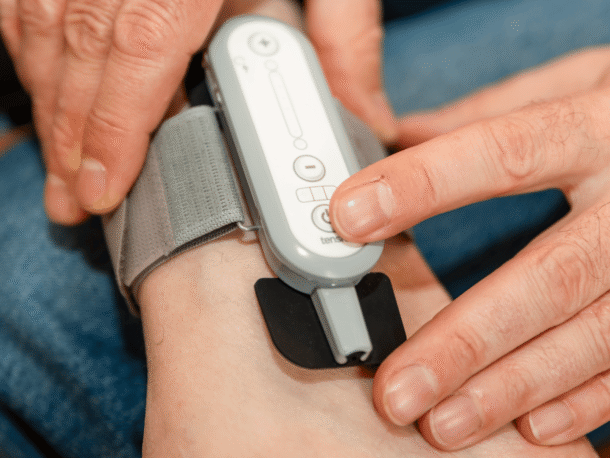
Tensi+ uses transcutaneous posterior tibial nerve stimulation (T-PTNS) to help relieve symptoms of overactive bladder, and is specifically suitable for people who wake at night to pee. Find out more on our Tensi+ page.

For some people, particularly those with limited mobility or additional continence needs at night, catheter options may form part of an overall night-time management plan, supported by advice from a continence nurse or GP. However, catheters are not routinely used to manage nocturia itself.


Tensi+

Tensi+ is a non-invasive, medicine-free device that uses tibial nerve stimulation to help manage overactive bladder symptoms, including nocturia and night-time urgency.

Can be used in the comfort and convenience of your own home – no need for repeat appointments

Many users see significant improvement after 12 weeks*

Suitable for adults of any age

Photo of a person wearing Tensi+ on their ankle.

*Success rate of 67% after 3 months usage. 88% of patients rated their experience with the Tensi+ device as positive – New TENSI+ Device for Transcutaneus Posterior Tibial Nerve Stimulation: A Prospective, Multicentre, Post-market Clinical Study, European Urology Focus (2024) J.-N. Cornu, L. Donon, C. Thullier et al.

Nocturia is the medical term for waking up regularly during the night because you need to pee

Causes for nocturia include: overactive bladder, prostate issues, diet and medication

Nocturia and overactive bladder (OAB) are not the same – OAB is a broader condition that can involve nocturia

Management of nocturia could include lifestyle changes, bladder training or specialised treatment

Tensi+ is a non-invasive medical device that can be used at home to help improve nocturia

Frequently asked questions

The most common cause of nocturia is nocturnal polyuria (where your body produces too much pee at night). This could be due to natural reasons, such as ageing or hormonal changes.