

An overactive bladder (OAB) can affect everyday life, confidence, and sleep. The good news is that support is available, and many people find relief with the right information and management options. In this page, we will highlight the symptoms and causes of overactive bladder and the different ways you can treat and manage the condition.
Note to readers: According to research from AgeUK, the word “pee” is generally preferred, so we’ve used it consistently throughout this page.
What is overactive bladder (OAB)?
Overactive bladder (also called OAB) is a condition that affects how the bladder stores and releases urine (pee). People with overactive bladder experience a sudden and uncontrollable urge to pee.
Overactive bladder occurs when the detrusor muscles (muscles within the wall of the bladder that help store pee) contract too frequently. This can make you need to pee more often which can lead to leaks and accidents.
Urge incontinence can be confused with overactive bladder as on the surface, they are quite similar. The difference is that OAB is a symptom-based condition and urge incontinence is a possible outcome of OAB.

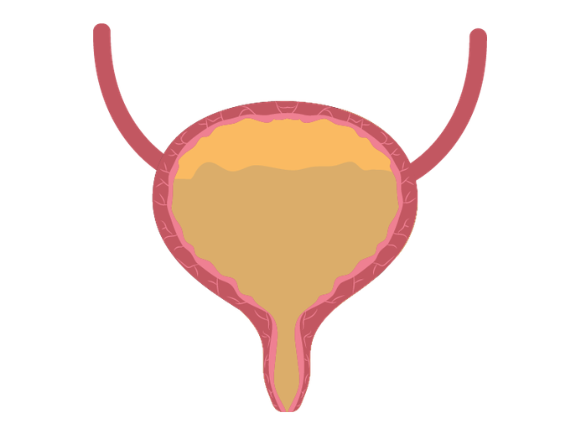
Normal bladder
The bladder muscles squeeze to push out pee once it’s full.
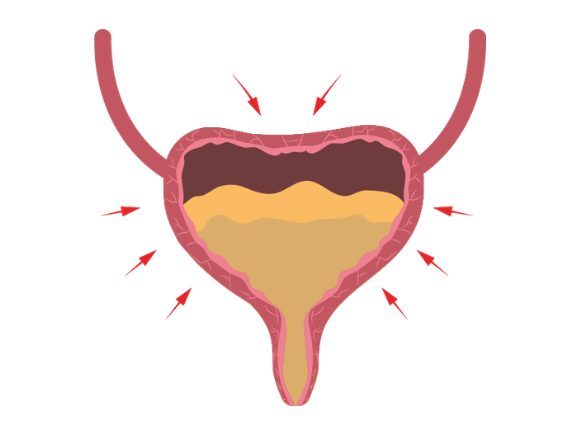
Overactive bladder
The bladder muscles squeeze to push out pee before being full.
Who does overactive bladder affect
Overactive bladder can affect men and women of all ages and is more common than many realise. In England alone, there are an estimated 5 million people with OAB and this number is expected to rise to over 7 million by 2035.1
Overactive bladder typically develops in adults aged 40 and over but it can affect younger adults too.
Although overactive bladder is more common in older adults, it isn’t an inevitable part of getting older. In fact, many people get older and experience no continence issues at all.
Overactive bladder (OAB) symptoms
If you have overactive bladder, you may experience:
Urgency
A sudden, strong urge to pee even when your bladder isn’t full
Frequency
Needing to pee more than usual, even if you have recently been to the toilet
Nocturia
Waking up multiple times in the night to pee
Leakage
Sometimes leaking before you reach the toilet (urge incontinence)
The severity of overactive bladder symptoms can vary from person to person, with some experiencing mild, occasional urgency while others have frequent, intense urges and incontinence.
Overactive bladder can disrupt everyday life by causing frequent, urgent trips to the bathroom that interfere with sleep, social activities and confidence. People with OAB can experience low energy, low self-esteem and may avoid social situations.
Overactive bladder and overlapping conditions
| Condition | Symptoms | Overlapping symptoms | Key differences |
|---|---|---|---|
| Urinary Tract Infection (UTI) | • A sudden, strong urge to pee • Needing to pee more than usual • Burning sensation when peeing • Changes to your pee: unpleasant, strong smell and a darker, cloudier appearance | • Urgency – a strong, sudden urge to pee • Frequency – needing to pee more than usual | The difference between UTIs and overactive bladder is that UTIs can be treated with antibiotics, whereas overactive bladder requires a different approach. Overactive bladder also doesn’t cause strong smelling pee or pain in your pelvic area. |
| Enlarged prostate (Benign Prostatic Hyperplasia, or BPH) | • Difficulty peeing or a weak stream of pee • Feeling like you cannot empty your bladder • Needing to pee more frequently • A sudden, strong urge to pee | • Urgency – a strong, sudden urge to pee • Frequency – needing to pee more than usual | Overactive bladder is caused by involuntary bladder muscle contractions, leading to a strong urge to pee even when the bladder isn’t full. Enlarged prostate restricts the flow of pee, making it difficult to start peeing or having a weak stream. |
| Bladder cancer | • Blood in your pee • Urgency – a strong, sudden urge to pee • Frequency – needing to pee more than usual | • Urgency – a strong, sudden urge to pee • Frequency – needing to pee more than usual | One of the main symptoms of bladder cancer is blood in your pee, which is not a symptom of overactive bladder. Bladder cancer is caused by a growth of cells, whereas overactive bladder is caused by involuntary muscle contractions. |
| Stress incontinence | • Leakage during activities that put pressure on your bladder, e.g. laughing or coughing | • Leakage | Although leakage is a symptom of overactive bladder and stress incontinence, the reason for the leak is different in both conditions. Leaks when you have overactive bladder are often caused by the urgent need to pee. Leaks when you have stress incontinence are caused by physical pressure, without any sudden urgency. |
How do I know if I have OAB?
Many people live with bladder symptoms for years without knowing what they are or where to turn.
Ask yourself:
Do you feel a sudden urge to urinate that’s hard to control?
Do you plan your day around toilet access?
Do you wake up more than once at night to urinate?
Do you worry about accidents and leaking?
If you answered “yes” to some of these questions, you may be experiencing symptoms of overactive bladder.
You’re not alone and help is available.

Overactive bladder causes
Overactive bladder is caused by the involuntary contractions of the detrusor bladder muscle (smooth muscle in the bladder wall that relaxes to store pee, and contract to release pee).
In many cases, overactive bladder is idiopathic (meaning it has no known cause), so it is unclear why this overactivity occurs. There are various factors that can contribute to overactive bladder, such as:
- Nerve and neurological conditions, like Parkinson’s disease or multiple sclerosis (MS)
- Lifestyle factors, such as being overweight or smoking
- Medical conditions like diabetes, bladder stones or Urinary Tract Infections (UTIs)
- Hormonal changes during menopause causing weaker pelvic floor muscles
- Obstructions like enlarged prostate (also known as BPH or Benign Prostatic Hyperplasia)
Overactive bladder diagnosis
GP appointment
To get diagnosed with overactive bladder, your first step is likely to be an appointment with your GP. Your GP may ask you questions about your medical history and if you are taking any medications.
Your GP could ask you to complete a bladder diary. A bladder diary is a document you complete daily to monitor how much fluid you are drinking and how often you need to pee during the day and night. Your GP will then review this to get a better understanding of your symptoms.
You may also be asked to give a sample of your pee so your GP can test for abnormalities like infection or blood in your pee. Your GP might want to examine you physically, this could be a pelvic or rectal examination.
Specialist referral
If your GP suspects you have overactive bladder, they may refer you to a continence specialist for further tests and examinations to understand your symptoms. These extra tests could include:
- Cystoscopy (where a camera is inserted in the bladder)
- Urodynamic testing (to test how your body releases and stores pee)
Overactive bladder treatment and management
There is no ‘one size fits all’ when it comes to treating and managing overactive bladder. The treatment you are given will depend on your lifestyle, overall health and the severity of your symptoms. Your treatment can also involve a few different approaches, these could include:
Medication
If you have overactive bladder, you may be given medication to help relax the bladder and relieve symptoms like urgency and frequency. You may be prescribed anticholinergics to help reduce spasms in the bladder or beta-3 agonists to help the bladder muscles relax. In more severe cases of OAB, you may be given Botox injections directly in the bladder. Medications can be an effective way to manage OAB but they can have unpleasant side effects.
Lifestyle changes
Symptoms of overactive bladder can sometimes be relieved just by simple changes to lifestyle. This could be through having a bladder-friendly diet and limiting things in your diet that irritate the bladder, such as alcohol or caffeine. Another change you could implement is to monitor the amount of fluids you are drinking during the day. On average, adults need 6–8 glasses of fluids a day (this includes water and other beverages).
Pelvic floor exercises
Pelvic floor exercises (also known as kegel exercises) can help improve symptoms of overactive bladder when performed consistently. The pelvic floor muscles contract and relax to control the flow of pee, and weakness in these muscles can lead to symptoms of incontinence.
Over time, regular pelvic floor exercises strengthen these muscles, providing better support for the bladder, improving bladder control, and reducing leakage.
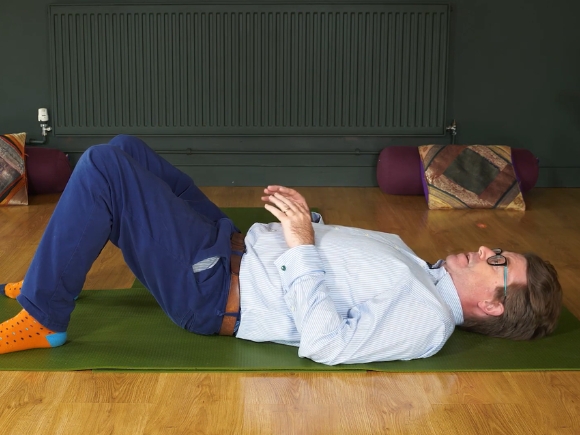
In this video, specialist physiotherapist, Gerard Greene demonstrates lying down pelvic floor exercises for men.
View the video transcript +–
Initially, doing pelvic floor exercises can be difficult for men, and the reason it’s difficult is we probably haven’t had to do them before. We’re doing exercises that are new to us and we’re trying to find muscles that maybe we weren’t too sure where they were, or that we even had them in the first place. So when we start the pelvic floor exercises, it’s easier to do the exercises initially in lying, and in lying what we’re really trying to do is just find those muscles and start to do some of the fast contractions, some of the slow contractions. Once we’re happy that we can do them in lying, then we would move to doing them in standing.
We want them to work in standing. We want to train them in standing because it’s in standing and moving that we’re going to have, whether it’s some bowel symptoms or some urinary symptoms. Once we can do them in standing, we’ll make it harder again by maybe doing some squatting, some lunging, adding some resistance.
Men find it really difficult to do pelvic floor exercises, and what you generally find is when they try and do any pelvic floor exercises, they contract everything: buttock muscles, tummy, jaw, sometimes even the hands. So what we’re going to do first of all is just go through what you’re not going to do. We’re going to start in lying because it’s an easier position to find these muscles. Before we do anything, what we’re going to do is just ensure that we’re breathing normally, and when we do the contraction we’re going to keep breathing normally. So I don’t want you to hold your breath, because a common thing people do when they try and contract is they’ll hold their breath.
We’re going to breathe normally, and we’re going to keep the tummy nice and relaxed, so when you do the contractions the tummy is going to stay relaxed. A lot of people will feel that they’ve got to tighten that tummy as hard as possible. We want to keep that relaxed, and we also want to keep the buttock muscles relaxed and keep those knees nice and soft. So just checking: breathing normally, tummy relaxed, buttock muscles relaxed, knees nice and soft. Then what we’re going to do is really focus on the front pelvic floor.
The front pelvic floor helps form that external or outer urethral sphincter valve. That’s what we need to contract around. So I’m going to get you initially to just visualise that you’re passing urine and that you’re going to stop mid-flow. So you’re just going to squeeze at the front as if you’re stopping mid-flow and let go. You’re going to imagine you’re passing urine, so you’re going to squeeze at the front, bit of a lift, imagine that you’re stopping mid-flow, and let go. Let’s just do a few of those initially, so you could do about maybe five or six of those initially just to get that stopping mid-flow sensation.
Next thing we’re going to do is the front squeeze, but this time we’re going to also imagine that we’re lifting the scrotum or testicles up a little bit. The phrase a lot of the men like and can visualise is we’re going to do a “nuts to guts,” so if we imagine we’re lifting up nuts to guts and let go. We’re going to do this big nuts to guts feeling and let go. Squeeze at the front, doing that nuts to guts and let go. What will get those front pelvic floor muscles starting to contract is doing that big scrotum lift, nuts to guts. So where do I feel this? I feel this kind of lower tummy, almost in that triangle below my belt (I’m wearing a belt); I feel it a little bit behind the scrotum. When you’re at home or on your own, if you put your hand in behind the scrotum to that soft area, which is the perineum, when you do the contraction you’ll feel that tighten a little bit and let go.
Initially, you’ll start doing that stopping mid-flow, let go, just to really find that front part. Then you’ll progress to doing the nuts to guts. Nuts to guts is what we want you doing, really. So nuts to guts and relax, but keeping the tummy relaxed, buttock muscles relaxed, breathing normally.
You’re going to now do things a bit more specifically. We want to do some fast pelvic floor contractions and some slow contractions. The fast ones are where I’m going to do a big front lift, nuts to guts lift. I’m going to do it nice and strong and fast. I’m going to nuts to guts, strong squeeze, let go; strong squeeze, let go; strong squeeze, let go. I’m going to try and build up to doing 10 of those.
It’s important when we’re doing all of this that we try and keep the back passage nice and relaxed. Now that’s difficult, but what you definitely don’t want to do is try and actively squeeze or contract. We really want the contraction at the front. If you’ve got urinary leakage, you want those front muscles to get stronger. Whereas if you do lots and lots of back passage contractions, they will almost prevent those front muscles from coming in. So we’re going to do some fast contractions, so that’s big nuts to guts, maximum contraction, let go; maximum contraction, let go. It’s important to relax in between the contractions.
With the slow contractions, we’re just going to do a lighter contraction, about 50–60%, so a little bit less. We’re going to contract a bit lighter at the front, nuts to guts, and we’re aiming to keep breathing and hold for one – 1, 2, 3—up to 10, and let go. That is difficult, so if you can’t hold for 10, that’s okay. You could hold for 5. You could start off doing 5 repetitions for 5 seconds, and once you feel “I can do that,” then you could do 8 for 8 seconds and then 10 for 10 seconds. We want you doing some fast contractions, 10, and then building up to doing 10 slow contractions for 10 seconds. You’re trying to really get to a point where you’re doing that three times per day. Once you can do it three times per day and you feel “I can do this,” then we want you to do them in standing—that’s really important.
It’s very important that if you’re experiencing any changes in urinary function, or changes in bowel function, changes in erectile function, or any pelvic-related pain, that you seek help from your GP. When doing the pelvic floor exercises, these should be comfortable to do and they should not be painful. It’s also important that you don’t overdo it. A lot of men doing pelvic floor exercises may feel that the more they do and the harder they do them, the quicker things will improve, but that tends to make things much worse or cause new problems. So it’s important to do small amounts as advised in the video, and do them gently as advised.
Another top tip is really for the men who’ve got particularly urinary frequency or urgency. So frequency is when I’ve just been to the loo and I feel I could go again. Urgency is where you get this sudden feeling that I need to urinate now, so instead of it being a very slow build-up, you go from not feeling like you need to urinate to suddenly feeling you need to urinate. Sometimes we use a technique called bladder training with those men, but it’s easier to do that if you can measure what your bladder pattern is like, and this is where we get men to fill in a bladder diary. CliniMed has a really good bladder diary that we can signpost you to.
Before we would do anything to try and change that pattern of urination, we get those men to measure it for about 5–7 days. Another good tip is to look at your hydration. It’s quite common that if men have urinary incontinence, or frequency, or urgency, it is intuitive to them to start to drink less. So you can end up that their fluid intake becomes too low, and that then makes things worse. That kind of intuition to drink less is actually making the problem much worse. We look at really what hydration or fluid intake is – how much water people are taking in, but also what people are taking in in terms of things that might irritate the bladder. So how much coffee am I drinking today, how much tea, how many carbonated drinks, how much alcohol – and it’s easier to modify or change that if you also do a hydration diary, which we can also signpost you to on the CliniMed website.
Two things that are going to really help with your pelvic floor exercises, and also whether it’s your urinary control, bowel control, or both. One of those is the Squeezy app for men. So Squeezy app for men is an award-winning NHS app, so it can be found in the Google Store, in the Apple Store, and you download it to your phone or device. It helps you do the fast contractions, it counts one fast contraction, it helps you with the slow contractions, so it’s kind of an aid to doing the exercises, and it also records how often you’ve done them. It helps you build up that you’ve done them twice today or three times. Men love the Squeezy app for men.
The second thing is doing the knack. So most men who’ve either got urinary incontinence or anal incontinence will be able to say, “Well, in these activities I’m leaking,” and the common ones are initially maybe going from sitting to standing, standing to sitting, bending down to the floor, lifting something, a cough or sneeze. What can happen there is the timing of those sphincters is out. If I’m going to cough, sneeze, or lift something heavy, what should happen is before I do that activity, that pelvic floor should contract, close those sphincters, so I can do that activity and I’m not leaking. That timing tends to be out when there is a pelvic floor issue, so what we’re going to get you to do is the knack.
Let’s say that I’m standing and I’m going to bend down to put my shoes back on. What I would do is a nice front contraction – let’s say I’m leaking urine –so I’ll do a nice front contraction, a nuts to guts strong contraction. I’m going to keep that contracted, I’ll bend down to my shoe, maybe tie that up, keep it contracted, and come back up. It may be that it’s when I get out of a chair. I’m sitting watching the TV, I’m fine, but once I get out of the chair I know that I’m going to leak some urine. What I would do is, in sitting, before I get up, contract at the front – a nice big nuts to guts front contraction –keep it contracted, stand up, then relax. You’re not going to need to do that forever—you tend to do that for a few weeks—and then that tends to help that timing so it becomes more automated.
Similarly, with people where they’ve got lack of control of wind, it may be that they pass wind when they cough or sneeze. What they will do is, they feel they’re going to cough or sneeze, they will do a nice squeeze around the back passage, keep that contracted, sneeze, relax. It may be that they feel they’re going to maybe get a little bit of faecal leakage—maybe they’re out playing golf and they feel they’re a bit nervous about bending down into the hole to pick the ball out. What they would do is a nice contraction around the back passage, bend down, and relax. This is really helping that kind of muscle patterning and muscle memory timing. So two things that are worth exploring are the knack, and then what will help you actually do the exercises in a more fun way is the NHS Squeezy app.
Electrical nerve stimulation
For some people, lifestyle changes alone may not provide enough symptom relief. In these cases, additional treatment options may be considered. Electrical stimulation is one approach used to help calm overactive bladder muscles and improve bladder control without medication.
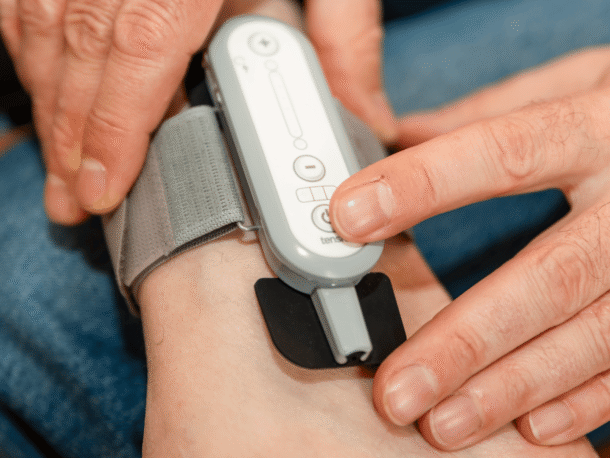
These methods can be practiced in your own home and are typically non-invasive. Tensi+ is a clinically-proven transcutaneous posterior tibial nerve stimulation (T-PTNS) device that is used for the treatment of overactive bladder. The device is suitable for adults of any age and provides a discreet way to manage overactive bladder, removing the need for hospital visits or medication.
Tensi+ for overactive bladder
Tensi+ is a home-use electrical stimulation therapy designed to help manage symptoms of overactive bladder.
In this video, Jenny shares her positive experience using Tensi+ alongside other lifestyle changes.
Tensi+ may be suitable for people looking for:
A medication-free treatment option
Support alongside lifestyle changes
A clinically-recognised approach to bladder control

Stress and overactive bladder
When you feel anxious or stressed, your body goes into ‘fight or flight’ mode. This can make your bladder more sensitive and make urinary frequency and urgency worse.
Over time this can create a cycle of worrying or anxiety about your symptoms, which can make them worse, leading to greater worry and anxiety.
Simple breathing and mindfulness techniques can help calm your body and manage feelings of stress and anxiety better.
In this video, Breathwork Coach, Rachel Whitehead, guides you through different breathwork, grounding and mindfulness techniques that can help you stay in control.
When to seek help
Speak to a healthcare professional or continence team if you persistent symptoms of overactive bladder (frequency, urgency, leakage or waking up in the night to pee). If your symptoms are impacting your everyday life, don’t delay speaking to a healthcare professionals. Symptoms of OAB can impact various areas of your life and there is support available to help you manage your condition and regain control.
Key takeaways
Overactive bladder is a condition that affects how pee is stored and released from the bladder, most commonly affecting older adults
Symptoms of OAB include urgency, frequency, leakage and needing to pee in the night
Various factors can contribute to OAB including hormonal changes, nerve and neurological conditions and lifestyle factors
Your healthcare professional may ask you to complete a bladder diary, do a physical examination or conduct specialist tests like a cystoscopy
You can manage overactive bladder through lifestyle changes, pelvic floor exercises, medication or electrical nerve stimulation
Tensi+ is a medication-free, clinically-recognised way to manage symptoms of overactive bladder
Seek help for OAB if you have persistent symptoms of OAB or if your symptoms are interrupting daily life
References
- The Urology Foundation, Overactive Bladder: Who’s Counting? [website] https://www.theurologyfoundation.org/impact-achievements/campaigns/overactive-bladder-whos-counting/ (accessed 18 February 2026)
Frequently asked questions
Overactive bladder doesn’t have a set timeline as the condition affects people differently. How long you will have symptoms of OAB depends on what is causing your symptoms and how it is being treated. Some people can improve their symptoms by simple changes to their lifestyle, where as others may need a combination of different approaches which can be more long term.
Some symptoms of overactive bladder do overlap with Urinary Tract Infections, so they can feel similar. OAB and UTIs can both cause a strong, sudden urge to pee (urgency) and needing to pee more than usual (frequency). UTIs can cause a burning sensation when peeing which is not a symptom of overactive bladder.
If you are unsure if you have OAB or a UTI, speak to a healthcare professional who can test your pee for an infection or abnormalities.
Yes, overactive bladder can happen suddenly and at any time. Symptoms can appear abruptly after a trigger, such as hormonal changes, exposure to bladder irritants or a neurological condition. However, some people can experience symptoms without being able to identify their triggers.
If you experience sudden or severe symptoms of OAB, speak to a healthcare professional to rule out infection and give a definitive diagnosis.
Anxiety and stress themselves do not cause overactive bladder but they can make symptoms of OAB worse. Anxiety and stress trigger the body’s ‘flight or fight’ response which can impact bladder function, tighten pelvic floor muscles and increase bladder contractions.
When you are feeling anxious or stressed, you may notice that you experience more sudden, strong urges to pee and you need to pee more often.
Overactive bladder doesn’t cause erectile dysfunction but symptoms of OAB may contribute to erectile dysfunction. For example, disturbed sleep from nocturia (waking up in the night to pee) can cause low energy and low mood which could contribute. Medications to treat OAB may also have an impact.
Support and resources
Find lots of helpful tips for living with incontinence in our resource library.
Tensi+
Learn more about Tensi+, a medicine-free, non-invasive, non-surgical treatment for overactive bladder that you can use in the comfort of your own home.

Guide to male incontinence products
Discover the different products available to men to help manage urinary incontinence.
Bladder Diary
Track daily activities, fluid intake and bathroom visits with our free downloadable bladder diary.

Your guide to catheter bags
Discover how to use, change and care for catheter bags. Get expert advice, step-by-step instructions, and explore our product range.