Skip to content

Your guide to urinary sheaths

Many men find that a urinary sheath offers a practical, discreet alternative to pads or protective underwear, helping them feel more confident and in control throughout the day.

In this guide, we’ll explain what a urinary sheath is, how it works, and how to apply and remove one safely. We also cover the benefits, finding the right fit, and connecting your sheath to a drainage bag – so you can choose an option that supports your routine and independence.

What is a urinary sheath?

A urinary sheath is a soft, flexible product that fits over the penis, similar to a condom. It is also called an external catheter or condom catheter. it works by directing pee into a leg or night drainage bag.

Many men choose a sheath as a comfortable and low‑profile way to manage incontinence, especially if they want an option that can feel less bulky than pads or pants.

You may find a sheath helpful if your incontinence is linked to prostate problems, neurological (nerve‑related) conditions, or surgery. It can also support you if you find it difficult to reach the toilet in time due to limited mobility.

View video transcript +

This video will show you how to use the CliniSure Urinary Sheath. The CliniSure Sheath is a soft silicone device that fits like a condom over the penis with a small outlet at the end that connects to a drainage bag. The CliniSure Sheath is made of high quality, flexible silicone to ensure comfort and security. For added peace of mind, CliniSure Urinary Sheath comes in discreet, no-noise packaging perforated to make each sheath packet easy to open.

CliniSure products are environmentally friendly and we have made every effort to remove as much plastic as possible. CliniSure Urinary Sheaths are easy to use and come in a wide range of sizes and styles. There are five different sizes from 24–40 millimeters and you can choose from three styles depending on penis length and shape for the best possible fit – pop on, standard, or wide band.

Before using a CliniSure Urinary Sheath, it is important to identify the correct size using the CliniSure Sheath measuring guide. Simply place the guide mid way along the flaccid penis at its widest point. If between sizes, choose the smaller size. If you are unsure about which size to select, speak to a healthcare professional before fitting.

Before you fit the CliniSure Sheath, make sure you have everything you need nearby. This may include:

  • Barrier wipes if using, we recommend the LBF wipes
  • A CliniSure drainage leg bag or your preferred brand
  • Leg bag straps or sleeve
  • A fixation device if using such as CliniFix

The supplied hair protector can be used to keep pubic hair out of the way when fitting the sheath. Simply take the hair protector and slide down the shaft of the penis ensuring all the pubic hair is behind the guard. You may also trim the pubic hair if desired but do not shave as this may cause irritation.

Using a barrier wipe, apply to the shaft of the penis but avoid the glands. Allow the skin to dry. Take the sheath from its packaging using the perforations for ease of opening. Minimise handling of the adhesive to maintain stickiness. Whilst holding the penis away from the body, hold the sheath by the spout and place on the end of the penis and gently unroll. Once the sheath is fully enrolled along the length of the penis, hold in place for up to one minute to help warm and activate the adhesive for a secure fit.

Tear off the hair protector to remove. Place your leg drainage bag on the leg and secure with the straps provided. Finally, securely connect the sheath spouts to a drainage pack taking care not to twist, making sure that the bag tap outlet is in the closed position during fitting.

The urinary sheath should be changed every 24 hours. The CliniSure Sheath can be removed by using warm soapy water or with a medical adhesive remover such as CliniPeel, designed to remove a sheath without causing pain or skin trauma, enabling quick and easy removal. You then simply dispose of the sheath in a waste bin.

Sign up to our home delivery service, SecuriCare to receive a regular continent supply. SecuriCare deliver direct to your door free of charge and offer ongoing support and advice. To find out more about CliniSure Urinary Sheaths, or our CliniSure range visit www.clinimed.co.uk

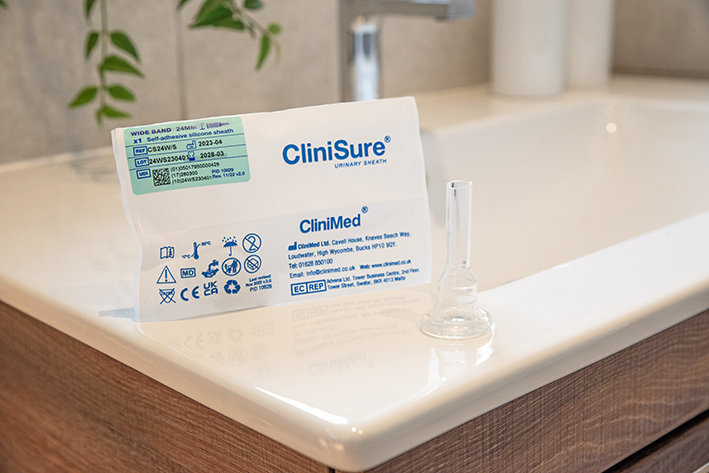
A CliniSure sheath next to its packaging on the corner of a sink.

Why use a urinary sheath?

Urinary sheaths are a non-invasive product for men looking for a discreet way to manage incontinence. They are useful for men who want to be active or want a continence product they can apply and remove independently.

In this video, David shares his experience using the CliniSure Urinary Sheath and the positive impact it has made to his sleep and quality of life.

View video transcript +

Anna: Hello, my name is Anna Mosley, I’m a Community Specialist Nurse. Today I’m going to be meeting David and Joan and listen to their experience using a CliniSure Sheath.

So a sheath is a product we would use in male urinary incontinence. It’s something I thought would work well for David as opposed to using an indwelling catheter. This is a non-invasive product that you just put over the penis and it attaches to a leg or a night bag and it helps to keep you dry.

So I’m here with David and Joan. David who’s been using the CliniSure Sheath. So when I first came out to do an assessment and see what size is going to work best for you and I left a few samples for you to try. How did you find because I know Joan you’ve been helping David, how did you find the ease of use of using the CliniSure Sheath?

David and Joan: Well once I got used to it after a few times I found it it goes on quite quickly.

Anna: Mhm. And how about taking it off, did you find it easy enough to remove the sheath?

David and Joan: Well, David does that actually. Yes, he can. He does it himself every day.  Mainly soap and water and that’s it.

Anna: So, David, obviously you’re wearing the sheath overnight. How did you find wearing it? Does it feel comfortable? Do you know it’s there?

David and Joan: It feels doesn’t feel at all uncomfortable so it’s okay from that point of view. I can get it off easily in the morning. I think the big advantage is because it isn’t indwelling, there’s no risk of infection and  there’s been no skin irritation. So from that point of view, it works very well.

Anna: And has there been any issues with it not staying on overnight?

David and Joan: No. No.

Anna: So, how do you feel, what the benefits been since you’ve been using it? What are the things that you could potentially do now that you didn’t feel like you could do before you had the sheath?

David and Joan: Well, now we’ve got into the routine, it’s very easy to use and it means that it’s freed us up to as I say go on short breaks. To leave the house. So much so that we can think of perhaps going on on a longer break.

Anna: Mhm. And your sleep, David, do you feel that you sleep better now you’ve got the the sheath on?

David and Joan: Oh yes. I can go for a long long time during the night without needing to do anything. So, it’s all it’s all good. That’s one of the most important benefits I think really. Because David can sleep then his his quality of life’s better because he feels so much better during the day.

Anna: So David, how long have you been using the sheath for now altogether?

David and Joan: About 18 months, I think.

Anna: 18 months. And if you had any any of your friends in a similar situation and they were kind of asking for your advice, would you suggest using a sheath?

David and Joan: Absolutely. Yes. A terrible shame not to use when the facility is there. I didn’t dream such things existed when first started out on this epic voyage.

Anna: It’s just getting the word out there, I suppose, letting people know. So, what would your advice be to anybody that’s in a similar kind of situation to you that are maybe looking at their options?

David and Joan: Well, I would encourage them to give the sheath a try. We didn’t know what to expect but because you came and explained it all and were very patient with u, we thought it was worth trying. So it’s made made such a difference to our lives. So if anyone is experiencing the same problems, I just encourage them to to try it.

They can be worn for up to 24 hours without needing to be changed

Made with flexible, soft silicone for comfort and security

Noise-free, easily openable packaging

Easy to apply and remove

Keeps the skin dry and protected from moisture, versus continence pads

Photo of David, CliniSure urinary sheath user

How to choose the right urinary sheath

Finding the right urinary sheath is essential for comfort and security. When choosing a urinary sheath, you should consider:

Sizing

Make sure to measure the penis accurately to get the best sized sheath for you. This will provide a secure fit that prevents any leaking.

Style

Choose a style that is most comfortable with your penis length and shape. At CliniMed, we offer a urinary sheath with a pop-on, standard or wideband style.

How to apply a urinary sheath

Before you apply your sheath, you want to make sure you have measured your penis and have a correctly-sized sheath. You can use the CliniSure measuring guide to help.

View the video transcript +

So, the first thing I have here is a measuring guide. So I’ll show you on the model I have here. If we went for this one, it would be slightly too big. If it’s too big, it’s going to come away. It’s not going to work for you. But if you go too small, it’s going to be uncomfortable. It’s going to be tight. Might be a bit restrictive. So, for this particular model, I would go for a 28.

You might notice as well when you get your sheets a product like this. This is what we call a hair guard. This goes over the top of the penis like so. And if you have any hair, helps to keep the hair back. Another product I would use is a barrier wipe. A barrier wipe is good for keeping the area clean, but also it makes the area quite tacky.

So, when you’re putting the sheath on, it helps to keep it nice and tight. So, I’m going to put a little bit of this barrier film on first. When you get the sheath, you have a little part like this, which you can tear down. And when you get the sheath out again, it looks a little bit like a condom. So it goes on the end of the penis like so. You grab the tip of the penis on the inside and it just rolls down really simply and there’s an adhesive inside there which just attaches itself to the penis. And because this is the right size, helps to keep it secure.

So sheets are incredibly tacky. So you’re going to need a way of how to take this off. If you still have your hair guard on, uh, to remove it, you just give it a little tear and it comes off nice and easily. You don’t have to have this on the whole time. You could actually take this off as soon as you’ve put the sheath on or you can keep it on the whole time. It’s whatever you’re comfortable with.

So, help to help to take the sheath off. I would use a medical adhesive remover. Without using this, if you’re taking them off every day, it’s going to get quite sore because, as I mentioned, it’s incredibly tacky. So, a little bit of a spray of the adhesive remover like so. And what that’s doing is it’s breaking down the glue. What I tend to do then is lift a little bit of the sheath and just spray in between the skin and the sheath. Helps to release the adhesive and it comes off nice and easily. Once it’s off, you just put this into your normal household waste.

Wash and dry your hands

Trim any pubic hair (if necessary) or apply a hair guard to help keep the pubic hair back and away from the sheath

Apply a barrier film to the penis to help the sheath fit comfortably (optional)

Take a sheath from the packaging without touching the adhesive, and place on the tip of the penis

Roll the sheath fully down over the penis, keeping the sheath straight

Hold the sheath in place with your hand until you feel the sheath is secure

Remove your hair guard from your penis, this can be removed by tearing

Connect the sheath to a leg or night drainage bag

Photo of Community Nurse Specialist, Anna Moseley

How to attach a catheter bag to a sheath

Watch a step-by-step video demonstration from Anna Moseley, Community Continence Nurse Specialist to see how to attach a catheter bag to a urinary sheath.

This video covers advice for attaching a leg bag and a night bag.

View the video transcript +

So, I’m going to talk a little bit how you’re going to attach a leg bag or a night bag onto a sheath.

This sheath is already in place. So, what you want to do is so with your leg bag, take the cap off like so. And what you want to do, there’s a little bit of an edge here. It doesn’t have to be all the way along. About one and a half or two rings will be absolutely fine. Putting it on the end of the sheath. And then what you’re doing is just pushing it ever so gently as far as you can manage. So, about one and a half. So, it’s nice and secure.

So, that’s your leg bag. If you wanted to move for a leg bag onto a night bag, you don’t have to take the sheath off, all you need to do is pull this off like so. And you can put the cap back on. And then at night time, take the cap off and you can then attach a separate bag onto the end of your sheath. Same thing again is just pushing it slightly higher like so. So, it’s secure.

Wash and dry your hands

Clean and dry your sheath outlet

Remove the cap from the tubing of your drainage bag

Connect the tubing of your catheter bag to the outlet of your sheath

Push the tubing into the sheath outlet, aiming to be pushed in about 1.5–2 rings deep of the connector

Check you have no kinks or twists in your tubing to avoid leaks

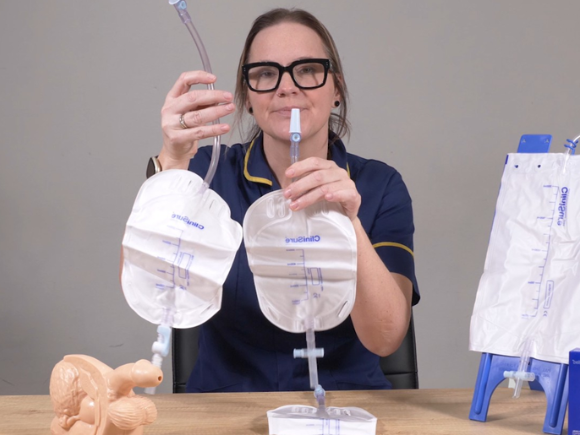
Photo of Anna holding two leg drainage bags

How to remove a urinary sheath

Use these steps to minimise discomfort and skin irritation when taking off a sheath.

Use a medical adhesive remover to pull away the sheath, or use soap and water

Avoid pulling quickly to prevent damage to your skin

Dispose of your used sheath in your general household waste

Allow the skin to breathe before applying a new sheath (if possible)

A packaged CliniSure sheath on top of its box next to a can of CliniPeel on top of folded clothes in a suitcase.

Frequently asked questions

Community Continence Nurse, Anna Moseley answers some frequently asked questions about living with a urinary sheath.

Photo of Anna Moseley with text 'Can you travel with a urinary sheath'

Can you travel with a urinary sheath?

Photo of Anna Moseley with text 'Clothing & urinary sheath'

What clothing works best with a urinary sheath?

Photo of Anna Moseley with text 'Can you have sex with a sheath'

Can you have sex with a sheath?

Graphic of a man running alongside text 'Can you exercise with a urinary sheath'

Can you exercise with a sheath?

Get support

Need help finding the right sheath or advice on managing your continence routine?

Our continence range

Explore the CliniMed range of urinary sheaths and continence accessories.

CliniSure urinary sheaths with packaging, hair protector and measuring guide

Urinary sheaths

View product
A CliniSure Sterile Night drainage bag in its packaging next to its box

Leg and night bags

View products
CliniSure catheter retaining strap folded

Securement and fixation products

View products

A urinary sheath is a soft, flexible device used to manage male incontinence

A sheath is fitted on the penis like a condom and connects to a catheter bag to drain pee from the body

You may need a urinary sheath if you have nerve or neurological conditions, recent surgery or prostate-related incontinence

CliniSure Urinary Sheath is discreet, easy to apply and remove, and can be worn for up to 24 hours

To get the best urinary sheath, explore different styles and make sure you have measured your penis accurately for a secure fit

Support and resources

Find lots of helpful tips for living with incontinence in our resource library

Image of three male friends exploring a city

Guide to male incontinence products

Discover the different products available to men to help manage urinary incontinence.

Learn more
Photo of Anna holding two leg drainage bags

Your guide to catheter bags

Learn the different types of catheter bags, sizes and configurations to support comfort, discretion, and independence in your daily life.

Learn more
A woman in a wheelchair sits at a dining table taking a croissant from a plate offered by a young man in casual clothes, they could be mother and son.

Bladder diary

Track daily activities, fluid intake and bathroom visits to gain insights into your urinary patterns.

Download your guide
Photo of a lady leaning on a kitchen counter eating chicken and salad

Food and diet for a healthier bladder

Get advice on living with a catheter, including helpful tips, solutions to common challenges and how to gain confidence.

Learn more