


Living with Fowler’s Syndrome can feel overwhelming, especially at the point of diagnosis. But with the right information, support, and tools, many people go on to live full, active lives. Understand what Fowler’s Syndrome is, hear from others with lived experience, and explore the management options available to support you.
What is Fowler's Syndrome?
Fowler’s Syndrome is a rare condition that affects the normal relaxation of the urethral sphincter (two muscles used to control the exit of urine), making it difficult to empty the bladder. It is a recognised cause of chronic urinary retention, most commonly affecting young women.
Because symptoms can develop suddenly and aren’t always well understood, many patients experience delays in diagnosis. Increased awareness is vital to ensure people receive timely assessment, reassurance, and appropriate management.
SecuriCare Community Specialist Nurse, Anna Mosely, has worked with patients to help them manage their continence. In this video Anna explains what Fowler’s Syndrome is.
View the video transcript +–
So what is Fowler’s Syndrome? Fowler’s Syndrome is a condition that affects younger ladies, anything between the ages of 20 and 30. But the average age that people tend to be diagnosed with Fowler’s Syndrome is 26.
The problem is that you are unable to pass waterand you can become in retention. Retention being that you’re holding the water in your bladder and this is due to your sphincter not being able to relax.
There’s also been some evidence which has shown that 50% of ladies that have been diagnosed with Fowler’s Syndrome can end up with polycystic ovaries.
Who does Fowler’s Syndrome affect?
Fowler’s Syndrome predominantly affects young women, typically in their 20s or 30s, with the average age of onset being 26. Although there is no set cause of Fowler’s Syndrome, there are some associations of the condition, such as childbirth and surgery. Many people with Fowler’s Syndrome also have endometriosis, and up to half are known to have PCOS (Polycystic Ovary Syndrome).
Due to the rarity and underdiagnosis of Fowler’s Syndrome, the exact number of people with the condition is unknown.
Fowler's Syndrome symptoms
Symptoms of Fowler’s Syndrome can vary from person to person, but commonly include:
Difficulty or inability to pass urine
A feeling of incomplete bladder emptying
Lower abdominal discomfort or pain
Recurrent Urinary Tract Infections (UTIs)
Sudden onset of urinary retention (not being able to empty your bladder completely or at all)
These symptoms can have a significant impact on daily life, mental wellbeing, and confidence, particularly when they appear without warning.

What causes Fowler’s Syndrome?
Fowler’s Syndrome is an idiopathic condition (meaning there is no known cause). Abnormal functioning of the urethral sphincter (two muscles used to control the exit of urine) could be due to abnormal nerve signalling or overactivity. More research is needed to determine exactly what causes the urethral sphincter to stop functioning properly.
There are some strong links of Fowler’s Syndrome with pre-existing conditions in women. A high correlation of people with Fowler’s Syndrome have been diagnosed with endometriosis or PCOS (Polycystic Ovary Syndrome)1. These associations suggest that Fowler’s Syndrome could be linked to hormonal conditions.
Fowler’s Syndrome is seen more commonly in women who have given birth, used opiates (drugs typically prescribed to relieve pain, such as Morphine), had surgery or have had an infection or illness.
How is Fowler’s Syndrome diagnosed?
Diagnosis often involves a combination of:
- Clinical history and symptom assessment
- Bladder scans to measure residual urine
- Urodynamic studies
- Electromyography (EMG) of the urethral sphincter in some cases
Reaching a diagnosis can be a lengthy and emotional process. Many patients describe feeling frightened or confused before they fully understand what is happening.
In this video, we met with content creator, blogger and ambassador for Fowler’s Syndrome UK, Elle Adams (@ellenextdoor) who shares how she was diagnosed with Fowler’s Syndrome and how she felt at the time.
View the video transcript +–
My name’s Elle Adams and I was diagnosed with Fowler’s Syndrome in October 2020 which coming up to five years and can’t believe that that time is gone so quickly, I’ve lived with Fowler’s Syndrome ever since.
Okay so just a little bit of history behind that so when did you first notice some problems or any symptoms, what made you realise something was wrong? It was all very sudden and quite dramatic really I’d never had a single symptom until I went to bed one night, woke up in the morning tried to pee and I just couldn’t. I thought I’ll give it an hour I’ll give it some time I’ll relax and nothing happened so it was at that point I I thought I need to go to A&E. Something needs to happen so that’s when I took myself off to A&E.
Yes that sounds quite scary, so you get to A&E I mean what did they do they examine you or? They did they used an ultrasound and they said you have a lot of fluid on your bladder. It’s must be quite uncomfortable as well? It was so uncomfortable. The only way that I can describe is if you are so desperate to pee and then you’re just left and left and left and there’s there’s no solution. So eventually I was catheterised and there was over a litre of urine on my bladder.
Was that the indwelling catheters so they put one in with the balloon and it attached to a bag was it? Yes, attached to a bag and it just kept coming it was just so.. relief I suppose? the relief was incredible and you know I it’s amazing really because it it was terrifying but I still so naively thought well this is just a one off you know. I’d never had anything like it before so I thought well this is just some strange thing that’s happened. This will be a funny story to tell people in a few days and I had no idea that this was really the beginning of the next chapter of my life.
Okay so they put the indwelling catheter in do they discharge you home with that catheter in and what’s the plan after that? Yeah so my options were take it out try again and they said to me we just really don’t think that you’ll go, that you’ve shown no signs of being able to. So the other option is go home with the indwelling catheter and come back when you get the next appointment which just happened to be two weeks later. Okay so you have the catheter at home for a couple of weeks it’s draining okay I suppose? yeah yeah. No problems go back into a hospital and they take it out? Yeah so I managed to get an earlier appointment within a week because I just I think especially when you’re new to catheters, I mean they’re never truly comfortable anyway but having an indwelling catheter for the first time was really quite an experience and you know physically tough mentally tough as well.
Of course, having strapped to your leg. Exactly. And just kinda not knowing what lies ahead. Is this gonna be me forever now or is this just a weird week. So I went back in and they performed a TWOC, a trial without catheter and again I was quite confident really I thought well you know can’t see why I wouldn’t be able to go and I failed that spectacularly and that’s when I was taught to self-catheterise.

Fowler’s Syndrome treatment and management
Fowler’s Syndrome treatment focuses on management as there is no cure for the condition. Management is tailored to the individual and may include:
Intermittent Self-Catheterisation (ISC) to safely empty the bladder and protect bladder health
Medications in selected cases
Specialist referral and ongoing monitoring
Sacral neuromodulation for suitable patients
Building confidence with self-catheterisation
For many people, ISC becomes an important part of maintaining bladder health and preventing complications and learning this skill can feel daunting at first. Our guides explain how to self-catheterise safely, tips to build confidence, the different catheter options available and answers to FAQs.
Choosing the right catheter for you
Not all catheters are the same, and patient choice matters. Trying different catheter types can greatly improve comfort and confidence, and CliniMed offers free product samples to help you find what works for you.
A gel catheter can provide a great alternative to hydrophilic catheters as they are:
Ready to use
Discreet and easy to carry
Designed to fit into everyday routines
View the video transcript +–
This film shows you how to empty your bladder safely, easily and completely with the Curan Lady ready-to-use female device. It is very important that the procedures for hygiene are followed thoroughly in order to prevent infections and guarantee a clean procedure. The Curan Lady is a unique, compact female device and has an attractive discreet and elegant design.
The Curan Lady is ready to use, easy to open and extremely user-friendly. Each catheter is individually tested and guaranteed safely to use. The Curan Lady is pre-lubricated with a water-based lubricant and guarantees low friction in the urethra upon insertion. The lubricant is mess-free and does not spill any liquids.
The Curan Lady features very smooth fire polished eyelets which makes insertion risk-free and prevents irritation and are free from the aggressive softening agents such as DEHP. The Curan Lady features a universal color-coded, soft and flexible connector which fit all types of urine bags.
The Curan Lady is easy to store in a small handbag or pocket and can be disposed of easily after use.
Preparation steps
First you need to prepare all the materials you need for catheterisation: Curan Lady catheter, wipes, water, soap and a mirror.You can empty your bladder sitting on the toilet, in a wheelchair or standing up. Most important is that you choose a comfortable position, it will help you empty the bladder easily and comfortably.
Catheterisation steps
Wash your hands thoroughly with water and soap to prevent contamination and infections. If there is no soap available use a disinfectant hand gel.
Choose a comfortable position and try to relax as much as possible.
Open the Curan Lady catheter by twisting the transparent cap.
Remove the cap and pull the catheter out of the packaging by the connector.
Position the catheter standing on a clean surface.
Separate the labia with the index and middle finger of one hand to locate the urethral entrance. If preferred, use a small mirror fixed between your thighs to locate the urethral entrance.
Clean the labia by using a clean wipe, wiping from front to back to reduce the risk of infection. Keep the labia spread to ensure a clean entrance. Be careful that the catheter does not touch anything before entering the urethra.
Pick up the catheter between your thumb and index finger, squeeze the soft connector so that this is closed.
When the catheter reaches the bladder, urine will start to flow immediately. When you close the connector, you can control the urine flow and make sure that the urine will drop into the toilet safely without any mess or spilling.
Insert the catheter gently into the urethra. If the catheter did not enter the urethra properly or if you accidentally touch the catheter tube, please withdraw the catheter and repeat the procedure by using a new clean and sterile catheter.
Slide the catheter smoothly into the urethra until you will reach the bladder. After approximately three to five centimeters you will reach the bladder.
When the urine starts to flow push the catheter one to two centimetres further in. Do not force if there are difficulties inserting the catheter in order to prevent urethral injury. When the urine flow stops withdraw the catheter slowly in small steps.
If the urine flow starts again during withdrawal ,discontinue withdrawal and wait for the flow to stop before resuming catheter withdrawal. It is very important that the entire bladder is emptied completely to prevent infections.
Aftercare
Store the catheter into the packaging and dispose of the used catheter and wipes in the regular waste bin. If no bin is available, you can put your catheter into the packaging while closing the packaging with a transparent cap and store it in your handbag or pocket.
Wash your hands after catheterisation.
Intermittent self-catheterisation is a procedure that takes approximately a couple of minutes and needs to be repeated three to six times a day. The catheter is packaged in a sterile manner and is intended for single use to ensure hygiene. The first times performing the procedure can cause a sensitive feeling in the urethra. The body needs to accept the procedure and this takes time, this is completely normal.
The Curan Lady is available in a box of 30 pieces and also in a box of five pieces which is very suitable for daily activities or travelling. Curan Lady – a unique, compact, ready-to-use female device which is extremely user-friendly, ready to use, guaranteed leakage-free and features smooth polished eyelets.
Curan, specialist in intermittent catheterisation and urology products.
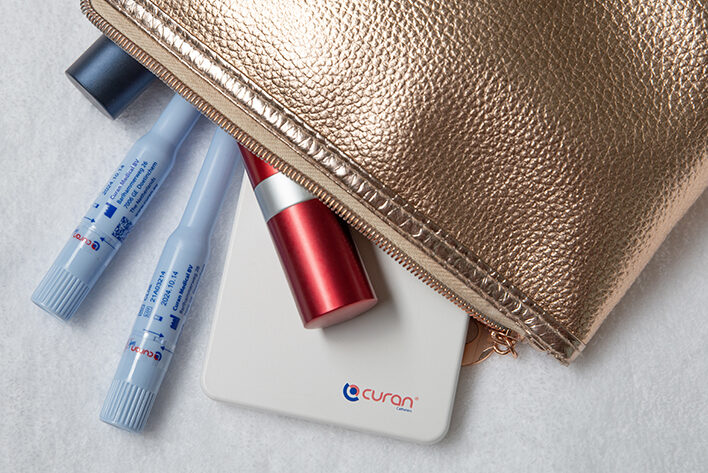
Curan Female catheters
The Curan range of catheters have been developed with your needs in mind, supporting patients who want to manage their condition while getting on with work, social life, and travel.
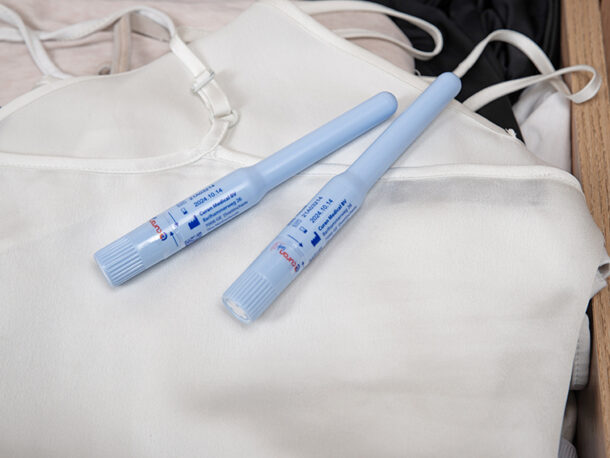
Curan® Gel Catheter
- Hydrogel coating for smooth and comfortable insertion
- Discreet, compact deisgn
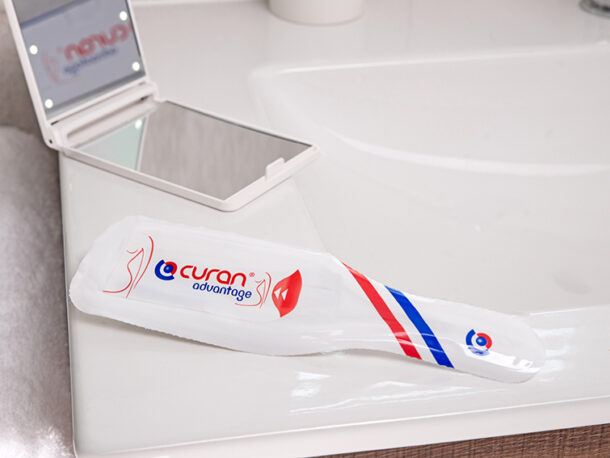
Curan® Advantage Hydrophilic Catheter
- Hydrophilic coating, activated with a sterile water sachet
- Low-friction insertion and removal
Elle's Journey – Living with Fowler's Syndrome
A diagnosis of Fowler’s Syndrome can feel life-changing – but it does not mean life has to stop.
With the right support, many people return to the activities that matter to them, including work, exercise, travel, and socialising. Finding a catheter that feels manageable and discreet can help restore confidence and independence.
We caught up with Elle Adams to find out how she “just gets on with life” and what has helped her feel in control again.
Watch the full discussion with Elle on our YouTube channel.
View the video transcript +–
So you’re introduced to ISC, so just so I have a better understanding did you meet a Nurse Specialist and how was it brought about, you know were you at the hospital or at home?
Yeah so I when I had the TWOC, I spoke to a consultant after who said you know your options are keep the indwelling catheter which was my idea of a nightmare. I really really didn’t want that because life is just you’re so inhibited aren’t you.
So they suggested ISC and it was a Nurse Specialist who taught me how to do that and it’s funny really because at the time it was so terrifying. I really didn’t want to have to do that because I just I guess I was in denial that this was where I was at and actually ISC has been the thing that’s changed my life and allowed me to live such a normal life now or as normal as can be with Fowler’s Syndrome.

When to seek medical help
It’s really important to detect Fowler’s Syndrome early so you receive an diagnosis and treatment options that work for you. Speak to your GP if you are experiencing:
A sudden inability to urinate
Persistent urinary retention (not being able to empty your bladder)
Recurrent Urinary Tract Infections (UTIs)
Support is available – and you don’t have to navigate this alone. The charity Fowler’s Syndrome UK can support you with educational resources, webinars and advice.
You can also reach out to a specialist Continence or Urology Nurse who can provide more specialist advice and solutions to help you manage your condition.
Frequently asked questions
Fowler’s Syndrome isn’t a genetic disorder, but gender does play a role in who is affected by the condition. Fowler’s Syndrome affects young women and does have strong correlations with other conditions affecting women, like Polycystic Ovary Syndrome (PCOS) and endometriosis.
Yes, Fowler’s Syndrome is a disability.
Fowler’s Syndrome is considered rare, but the exact number of people with the condition is unknown. Studies estimate that Fowler’s Syndrome impacts two per one million women1.
There is currently no cure for Fowler’s Syndrome. There are treatment options that allow you to manage the condition, such as catheters, medication and sacral neuromodulation. Treatment will vary from person to person and will depend on what works for you.
There are no known cases of men with Fowler’s Syndrome. The condition impacts women, typically between the ages of 20 and 30.
References
- Fowler’s Syndrome UK, Symptoms and Causes of Fowler’s Syndrome [website] https://fowlerssyndrome.co.uk/symptoms-and-causes-of-fowlers-syndrome/ (Accessed 19 December 2025)
Support and resources
Find lots of helpful tips for living with incontinence in our resource library.
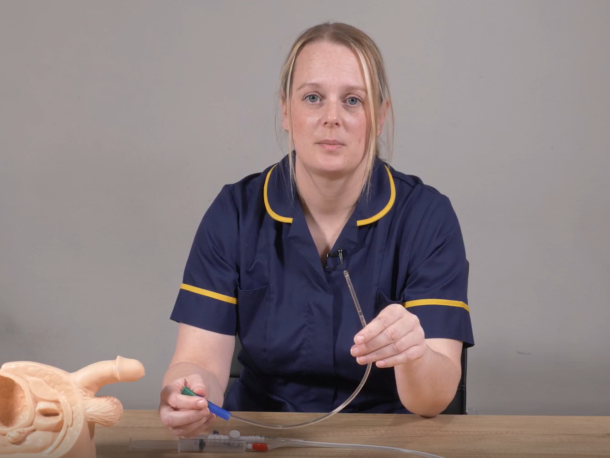
How to self-catheterise
Learn how to self-catheterise safely and comfortably with this step-by step guide.
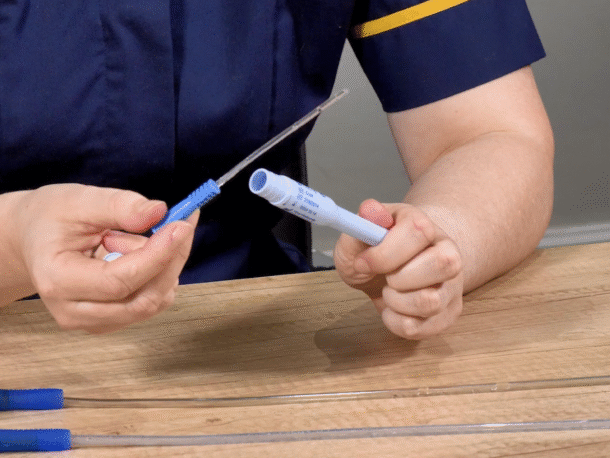
Guide to self-catheterising
Explore the differences between gel and hydrophilic catheters, the Curan catheter range and tips for living with ISC.

Bladder diary
Track daily activities, fluid intake and bathroom visits to gain insights into your urinary patterns.

Urinary incontinence catheter care guide
Get advice on living with a catheter, including helpful tips, solutions to common challenges and how to gain confidence.